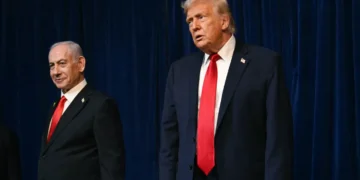




US President Donald Trump continues to send mixed signals regarding Venezuela, amid escalating tensions following the seizure of an oil tanker off the country’s coast on Wednesday. This move increases pressure on Caracas and raises questions about Washington’s strategy.
Several observers are questioning the US strategy, which appears to be balancing its stated goals of combating drug trafficking with pursuing regime change in Caracas. This comes against the backdrop of a significant US military presence in the region and strikes on boats suspected of involvement in drug trafficking.
A Ground Operation
In an interview with Politico on Tuesday, the US president said that Venezuelan President Nicolás Maduro’s “days are numbered,” without revealing how he intends to achieve this.
When asked whether he ruled out sending US ground troops, Trump avoided a definitive answer, aware that any major operation, such as a full-scale invasion—which many consider unlikely—lacks political support in the United States.
Nevertheless, Trump has publicly confirmed that he has authorized covert operations in Venezuela and indicated weeks ago that ground operations could occur “very soon.”
Will Freeman of the Council on Foreign Relations believes that the US military buildup in the Caribbean may be “more of a psychological operation than a military one, aimed at intimidation and creating panic.”
What are the likely targets
Phil Johnson, a Venezuela expert at the International Crisis Group, suggests that the US administration might consider it “extremely embarrassing and highly untrustworthy to simply order the fleet to leave” without taking any action.
The US has already deployed a massive naval force to the Caribbean, including 11 ships, among them the aircraft carrier USS Gerald R. Ford, the largest in the world.
“We might see some kind of ground intervention, most likely in Venezuela and possibly Colombia,” Freeman says. “But I don’t think that would be enough to topple Maduro.”
Experts predict that the US will target “military installations” that it claims are involved in drug trafficking, or “one of the ELN camps near the Colombian border,” Freeman explains.
Washington might also target drug labs, although the number of such sites in Venezuela is limited, according to Johnson.
Many agree that fentanyl, the leading cause of overdose deaths in the US, originates primarily from Mexico.
But Washington has designated a number of drug cartels in the region as “foreign terrorist organizations,” including the “Cartel de los Soles” (Cartel of the Suns) in Venezuela, which could provide justification for any attack.
What is the ultimate goal
When asked by Politico about his ultimate goal, Trump replied, “To treat the Venezuelan people well.”
During his first term (2017-2021), he pursued a policy of “maximum pressure” against Venezuela, with little to show for it.
The US president is not a proponent of regime change; rather, he favors a diplomacy based on “deals,” which he attempted to implement with Maduro by sending his envoy, Richard Grenell.
However, US Secretary of State Marco Rubio, of Cuban descent and known for his hostility toward the authorities in Caracas and Havana, pushed for a more hardline policy within a few months.
Despite all this, experts question the effectiveness of this strategy.
“I expect Maduro to remain in power,” says Freeman, without ruling out the possibility of Washington and Caracas reaching an agreement that Trump could present as an achievement—”an agreement on migrants, drugs, or some other issue.”
Johnson, however, believes that if the United States were to overthrow Maduro, there would be “many angry statements condemning the use of force,” but “many would breathe a sigh of relief in private.”