













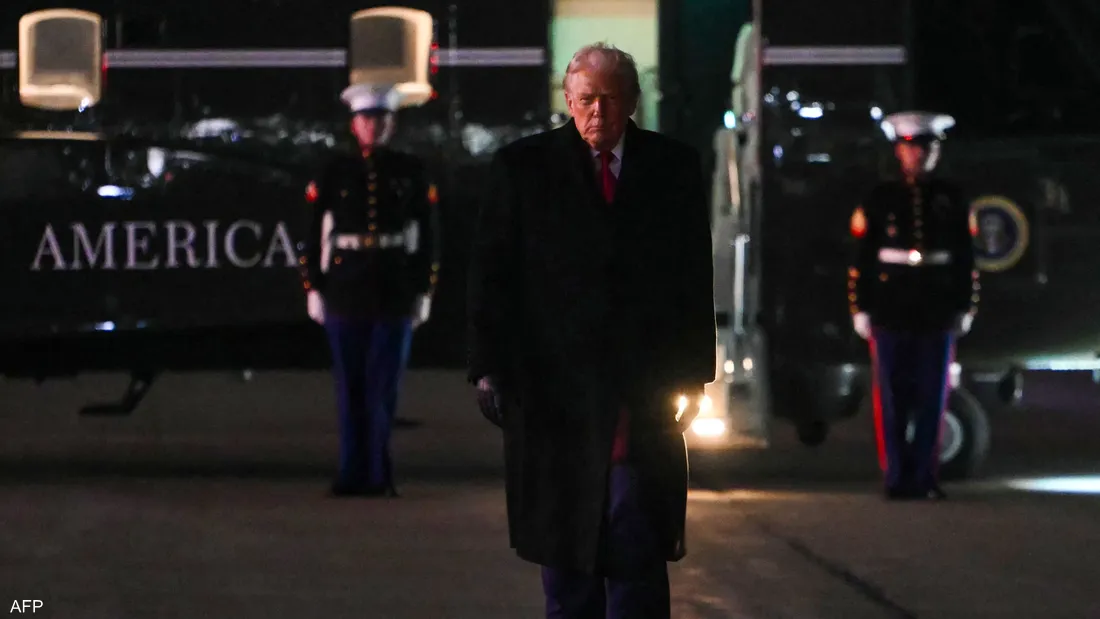
Analyst Henry Sokolski argues that while commentators have widely criticized President Donald Trump’s new national security strategy, they have overlooked what it lacked: no mention of expanded nuclear deterrence and nonproliferation.
Sokolsky, executive director of the Center for Nonproliferation Policy Education, former deputy director of nonproliferation policy at the U.S. Department of Defense (1989-1993), and author of “China, Russia, and the Coming Cold War” (2024), said this is troubling because America’s security has long depended on properly addressing these two interconnected issues, and ignoring or misunderstanding their relationship is risky.
He added, in a report published by the American magazine “The National Interest,” that there is an academic argument that having more countries possess nuclear weapons might be better.
Some realists insist that Washington should encourage America’s friends to become nuclear powers as a cheap way to maintain peace.
However, adopting this policy would undermine one of America’s most successful strategies: extending its nuclear deterrent by committing to its use, if necessary, to protect its allies. Ironically, the National Security Strategy makes no mention of this.
This omission may reflect the Trump administration’s optimism that the Golden Dome missile defense system will protect America from missile threats.
“However,” Sokolsky continued, “the system will take time to develop. Until then, America’s security, and that of its allies, will depend, as it has for decades, on the threat of force and, if necessary, the use of nuclear weapons to deter our adversaries.”
This may displease isolationist hawks. But extended deterrence has helped prevent a repeat of the total wars into which the Americans were drawn in 1917 and 1941. It has also prevented the Cold War from escalating into a hot war.
Why is this a problem
Sokolski explains: “Because both World Wars began, at least in part, with risky diplomatic experiments in dealing with a world possessing vast arsenals. In 1939, Poland tried to save itself by signing a non-aggression pact with then-German Chancellor Adolf Hitler, and this emboldened him to proceed with his plan. At the same time, Soviet leader Joseph Stalin agreed to turn a blind eye to Hitler’s invasion of Poland in order to secure his share of Polish territory.”
He added: “Similarly, before World War I, European powers frantically sought secret diplomatic security guarantees while simultaneously planning military mobilization.”
Sokolsky asked: “Did these carefully calculated maneuvers bring peace and stability? The answer is no. Yet, are we now being led to believe that deploying more powerful nuclear weapons among smaller states will bring peace and stability ”
Sokolsky noted that those eager to reduce extended deterrence say yes. They question why America should deploy troops abroad or spend billions to project power and protect its allies when “our friends” can defend themselves with nuclear weapons? America could then withdraw and spend less on its own defense
He went on to say that this might happen, but history suggests otherwise. After Britain, France, Israel, and Pakistan became nuclear-armed states, America actually spent more, not less, on defense. And the argument that American national security interests are served by staying out of other people’s wars is a valid one.
He continued: “Contrary to the desire to reduce defense spending, such deterrence requires constant modernization of military command, control, communications, intelligence, surveillance, and delivery systems to remain credible. Initially, any new, small nuclear force is relatively vulnerable. This is why extended deterrence has been one of the most effective U.S. strategies for preventing nuclear proliferation. It has helped prevent Italy, Sweden, Japan, South Korea, Australia, Germany, Turkey, and Taiwan from becoming nuclear-armed or manipulating the rules-of-war. Encouraging allies to become nuclear-armed states would be a different matter. If Washington encourages Seoul to acquire a nuclear bomb, a dovish South Korean president might then ask U.S. forces to leave the Korean Peninsula. And what would happen if the two Koreas, each with its own nuclear arsenal, decided to form a federation ”
He added: “History allows us to look at other possibilities. In 1956, Israel joined Britain and France to control the Suez Canal. Russia threatened to intervene and use its nuclear weapons. Then-US President Dwight Eisenhower had to force Britain, France, and Israel to withdraw. Would things have calmed down if Israel had possessed a nuclear bomb? And in 2003, the belief that then-Iraqi President Saddam Hussein was building a nuclear program drew US military forces into the region for nearly a decade.”