








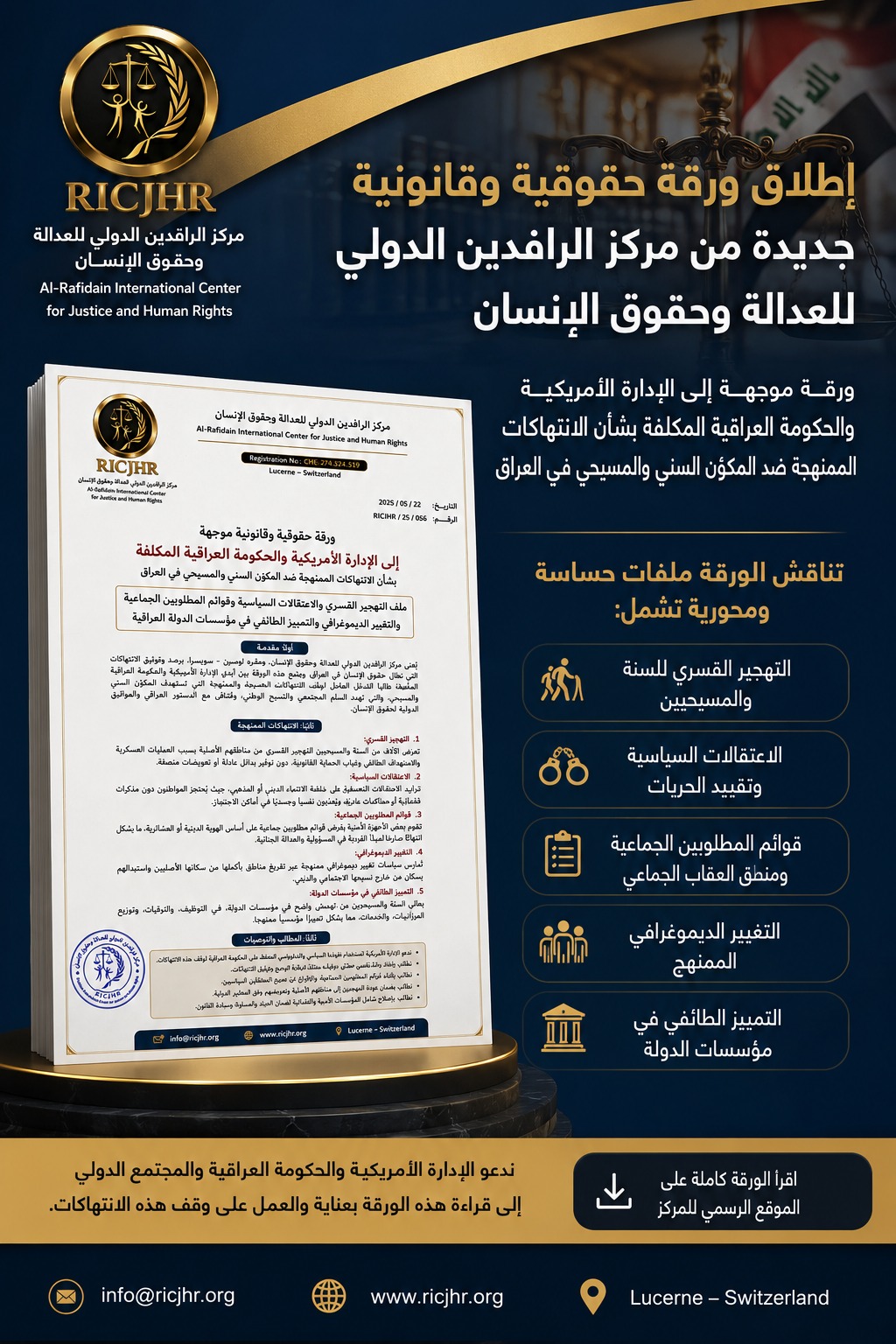
مركز الرافدين الدولي للعدالة وحقوق الإنسان
ورقة حقوقية وقانونية موجهة إلى الإدارة الأمريكية والحكومة العراقية المكلفة
بشأن الانتهاكات الممنهجة ضد المكوّن السني والمسيحي في العراق
وملف التهجير القسري والاعتقالات السياسية وقوائم المطلوبين الجماعية
والتغيير الديموغرافي والتمييز الطائفي في مؤسسات الدولة العراقية
________________________________________
الجهات الموجّه إليها
• الإدارة الأمريكية
• وزارة الخارجية الأمريكية
• الكونغرس الأمريكي
• لجنة الحريات الدينية الدولية الأمريكية USCIRF
• بعثة الأمم المتحدة لمساعدة العراق UNAMI
• مجلس حقوق الإنسان التابع للأمم المتحدة مجلس حقوق الإنسان التابع للأمم المتحدة
• المفوض السامي لحقوق الإنسان مفوضية الأمم المتحدة السامية لحقوق الإنسان
• الحكومة العراقية المكلفة برئاسة السيد علي الزيدي
• رئاسة الجمهورية العراقية
• مجلس النواب العراقي
• مجلس القضاء الأعلى في العراق
________________________________________
مقدمة
منذ عام 2003 دخل العراق مرحلة عميقة من الانهيار المؤسسي والتفكك المجتمعي، رافقها تصاعد نفوذ الجماعات المسلحة المرتبطة بالمشروع الإيراني داخل مؤسسات الدولة الأمنية والعسكرية والسياسية والقضائية، الأمر الذي أدى إلى إنتاج منظومة حكم قائمة على الإقصاء الطائفي والتغيير الديموغرافي والانتقام السياسي واستخدام القوانين والملفات الأمنية كوسائل للسيطرة المجتمعية وإعادة هندسة التركيبة السكانية في عدد من المحافظات العراقية.
لقد شهد العراق خلال العقدين الماضيين انتهاكات جسيمة وواسعة النطاق شملت:
• التهجير القسري الجماعي
• الاعتقالات التعسفية
• الإخفاء القسري
• المحاكمات غير العادلة
• التعذيب وانتزاع الاعترافات بالقوة
• مصادرة الممتلكات
• منع عودة السكان الأصليين
• استخدام قوانين مكافحة الإرهاب بصورة انتقائية
• التمييز الطائفي داخل مؤسسات الدولة
• عسكرة المدن والمجتمعات
• تقويض استقلال القضاء
وقد تركزت آثار هذه السياسات بصورة خاصة على العرب السنة والمسيحيين في عدد واسع من المحافظات العراقية، ما أدى إلى تدمير البنية المجتمعية والاقتصادية لمدن كاملة، وإنتاج ملايين اللاجئين والنازحين داخل العراق وخارجه.
إن هذه الورقة تمثل نداءً حقوقياً وقانونياً وإنسانياً عاجلاً يهدف إلى منع استمرار الانهيار المؤسسي في العراق، ووضع حد لسياسات الانتقام الجماعي والتغيير الديموغرافي، وإعادة الاعتبار لمبادئ العدالة وسيادة القانون والمواطنة المتساوية.
________________________________________
أولاً: التهجير القسري والتغيير الديموغرافي
تعرضت محافظات عراقية واسعة ذات غالبية سنية ومسيحية منذ عام 2003 وحتى اليوم إلى عمليات تهجير ممنهجة رافقتها انتهاكات خطيرة شملت القتل خارج القانون، وحرق المنازل، والاستيلاء على الأراضي والعقارات، ومنع عودة السكان الأصليين، وفرض وقائع ديموغرافية جديدة بالقوة المسلحة.
وتتحمل جماعات مسلحة مرتبطة بالحرس الثوري الإيراني مسؤولية مباشرة أو غير مباشرة عن جزء كبير من هذه الانتهاكات، وسط غياب واضح للمحاسبة القضائية الحقيقية.
1. جرف الصخر – محافظة بابل
منذ عام 2014 مُنع عشرات الآلاف من السكان السنة من العودة إلى مدينة جرف الصخر بعد سيطرة فصائل مسلحة مرتبطة بإيران على المنطقة، رغم انتهاء العمليات العسكرية منذ سنوات.
وقد تحولت المدينة إلى منطقة مغلقة أمنياً يُعتقد أنها تُستخدم كمراكز نفوذ عسكري ومخازن سلاح وممرات لوجستية مرتبطة بالحرس الثوري الإيراني والفصائل الحليفة له.
إن استمرار منع العودة يشكل انتهاكاً واضحاً لـ:
• المادة 13 من الإعلان العالمي لحقوق الإنسان
• المادة 12 من العهد الدولي الخاص بالحقوق المدنية والسياسية
• المبادئ التوجيهية للأمم المتحدة بشأن النزوح الداخلي
2. محافظة ديالى
شهدت مناطق المقدادية وجلولاء والسعدية والخالص عمليات تهجير واسعة رافقتها:
• عمليات قتل خارج القانون
• إحراق للمنازل والمساجد
• الاستيلاء على الممتلكات
• فرض وقائع ديموغرافية جديدة بالقوة المسلحة
كما تعرضت العائلات العائدة إلى ضغوط أمنية وابتزاز وتهديدات مستمرة أدت إلى استمرار النزوح بصورة غير معلنة.
3. محافظة نينوى وسهل نينوى
تعرض المسيحيون العراقيون إلى واحدة من أكبر موجات التهجير في تاريخ العراق الحديث بعد اجتياح تنظيم داعش للموصل وسهل نينوى عام 2014.
كما تعرضت مناطق سنية واسعة في الموصل والبعاج والحضر وتلعفر بعد التحرير إلى:
• اعتقالات جماعية
• انتهاكات انتقامية
• قيود على العودة
• ممارسات أمنية ذات طابع جماعي
ورغم هزيمة تنظيم داعش عسكرياً، فإن آلاف العائلات ما تزال عاجزة عن العودة بسبب تعدد مراكز النفوذ المسلح وغياب الثقة بالمؤسسات الأمنية والقضائية.
4. محافظة صلاح الدين
شهدت تكريت وبيجي والدور والعلم موجات نزوح جماعي وقيوداً أمنية مستمرة أعاقت عودة العديد من السكان حتى بعد انتهاء العمليات العسكرية.
5. جنوب بغداد وحزام بغداد
تعرضت مناطق اللطيفية واليوسفية والمحمودية والمدائن والعزيزية إلى عمليات تغيير ديموغرافي تدريجية منذ سنوات الحرب الطائفية، وسط اتهامات مستمرة لفصائل مسلحة بإجبار السكان على مغادرة مناطقهم أو منع عودتهم.
كما شهدت مناطق واسعة من محيط بغداد اختلالاً ديموغرافياً واضحاً نتيجة:
• السيطرة المسلحة
• الاستحواذ على الأراضي
• الاستيلاء على العقارات
• الضغوط الأمنية والطائفية
• التمييز في الخدمات والإجراءات الإدارية
________________________________________
ثانياً: أزمة قوائم المطلوبين الجماعية والاشتباه الأمني الجماعي
يُعد ملف التوسع غير المنضبط في إدراج المواطنين ضمن قواعد بيانات أمنية وقوائم “الإرهاب” أحد أخطر الملفات الحقوقية في العراق اليوم.
وتشير تقديرات وبيانات متداولة في الأوساط الحقوقية والسياسية إلى وجود مئات الآلاف من المواطنين العراقيين المدرجين ضمن قواعد بيانات أمنية بدرجات متفاوتة دون وجود أدلة جنائية مباشرة أو أحكام قضائية مكتملة بحق نسبة كبيرة منهم.
وقد ارتبطت هذه الملفات غالباً بـ:
• البقاء داخل المدن التي سيطر عليها تنظيم داعش
• ورود الأسماء في قواعد بيانات غير مدققة
• الإخبارات السرية
• الخصومات الشخصية والعشائرية
• الاشتباه القائم على الانتماء الجغرافي أو العائلي
إن اعتماد مفهوم “الاشتباه الجماعي” يشكل انتهاكاً خطيراً لمبادئ العدالة الجنائية الفردية المنصوص عليها في القانون الدولي، والتي تؤكد أن المسؤولية الجنائية شخصية ولا يمكن افتراضها على أساس الانتماء الجغرافي أو الطائفي أو الاجتماعي.
________________________________________
ثالثاً: الاعتقالات السياسية والتعذيب والمحاكمات غير العادلة
وثقت منظمات حقوقية محلية ودولية على مدى سنوات:
• الاعتقال التعسفي
• الإخفاء القسري
• التعذيب داخل مراكز الاحتجاز
• انتزاع الاعترافات بالقوة
• غياب الضمانات القضائية
• إصدار أحكام إعدام وسجن مؤبد استناداً إلى اعترافات قسرية
وقد تحول قانون مكافحة الإرهاب في العديد من الحالات إلى أداة تستخدم بصورة انتقائية ضد شريحة اجتماعية محددة، خصوصاً في المحافظات السنية.
إن استمرار هذا النهج يمثل تهديداً مباشراً للسلم الأهلي ويقوض ثقة المواطنين بمؤسسات الدولة والقضاء.
________________________________________
رابعاً: التمييز الطائفي داخل مؤسسات الدولة ووزارة الداخلية
تعاني شرائح واسعة من العراقيين، خصوصاً المقيمين خارج العراق ومن أبناء المحافظات المتضررة، من تمييز واضح في الإجراءات الإدارية والأمنية المتعلقة بـ:
• استخراج الجوازات
• البطاقة الوطنية
• المستمسكات الثبوتية
• الموافقات الأمنية
• ملفات العودة إلى العراق
وقد تحولت بعض دوائر وزارة الداخلية والمؤسسات الأمنية إلى بيئات تمييز غير معلن تستند إلى الخلفية الطائفية أو الجغرافية أو السياسية.
كما تواجه عائلات كثيرة عراقيل معقدة في:
• تحديث السجلات المدنية
• استعادة الوثائق الرسمية
• الحصول على الموافقات الأمنية
• تسوية أوضاع المطلوبين أو المشمولين بالاشتباه الأمني
إن استمرار هذه السياسات يكرس الانقسام المجتمعي ويمنع عودة ملايين العراقيين إلى الحياة الطبيعية.
________________________________________
خامساً: أزمة اللاجئين والنازحين العراقيين
أدت هذه السياسات إلى إنتاج ملايين العراقيين بين نازح ولاجئ داخل العراق وخارجه.
ولا تزال أعداد كبيرة من العراقيين تعيش في تركيا والأردن وأوروبا ودول أخرى غير قادرة على العودة بسبب:
• مذكرات قبض ذات طابع سياسي أو طائفي
• ملفات قائمة على المخبر السري
• الخوف من الاعتقال التعسفي
• تهديدات الجماعات المسلحة
• غياب الضمانات القضائية والأمنية
إن استمرار هذا الواقع يهدد مستقبل العراق ويؤدي إلى نزيف بشري واقتصادي واجتماعي خطير.
________________________________________
سادساً: النفوذ الإيراني وعلاقته بملفات التهجير والقمع
لا يمكن فصل ما يجري في العراق عن تنامي النفوذ الإيراني داخل المؤسسات الأمنية والعسكرية والسياسية.
لقد جرى توظيف الجماعات المسلحة والملفات الأمنية والقضائية في:
• فرض التغيير الديموغرافي
• ملاحقة المعارضين والنشطاء
• إسكات الأصوات الرافضة للنفوذ الخارجي
• استخدام ملف الإرهاب كأداة للهيمنة السياسية والمجتمعية
وكما تحولت بعض المناطق المهجرة إلى:
• مواقع نفوذ عسكري
• مخازن سلاح
• ممرات لوجستية
• قواعد مرتبطة بالحرس الثوري الإيراني
وهو ما يشكل تهديداً مباشراً لسيادة العراق وأمنه واستقراره الداخلي والإقليمي.
________________________________________
سابعاً: المطالب الرسمية والحلول والمعالجات
يطالب مركز الرافدين الدولي للعدالة وحقوق الإنسان بما يلي:
1. إعادة جميع المهجرين والنازحين قسراً إلى مناطقهم الأصلية بصورة آمنة وكريمة ودون أي تمييز طائفي أو سياسي، مع ضمان حمايتهم القانونية والأمنية.
2. إنهاء منع العودة إلى جرف الصخر والمناطق المغلقة الأخرى وفتحها أمام سكانها الأصليين تحت إشراف حكومي ودولي مستقل.
3. تشكيل لجنة دولية مستقلة للتحقيق في ملفات:
o التهجير القسري
o التغيير الديموغرافي
o الإخفاء القسري
o التعذيب
o الانتهاكات المرتبطة بملفات الإرهاب والاعتقالات الجماعية
4. إجراء مراجعة قضائية شاملة وعاجلة لجميع قوائم المطلوبين وملفات الاشتباه الأمني وفق المعايير الدولية للعدالة وحقوق الإنسان.
5. إلغاء مبدأ الاشتباه الجماعي واعتماد المسؤولية الجنائية الفردية فقط، بما ينسجم مع الدستور العراقي والقانون الدولي.
6. إسقاط التهم والملاحقات عن كل شخص لا توجد بحقه أدلة جنائية مادية مباشرة أو أحكام قضائية عادلة ومستوفية للضمانات القانونية.
7. إلغاء الاعتماد على المخبر السري والاعترافات المنتزعة تحت التعذيب في القضايا الجنائية والإرهابية.
8. فتح تحقيقات مستقلة وشفافة بشأن مراكز الاحتجاز والسجون وادعاءات التعذيب والإخفاء القسري والمحاكمات غير العادلة.
9. ضمان استقلال السلطة القضائية العراقية ومنع أي تدخل سياسي أو مسلح أو خارجي في عمل القضاء والمحاكم.
10. إطلاق سراح المعتقلين الأبرياء والمعتقلين على خلفيات سياسية أو طائفية ممن لم تثبت بحقهم جرائم وفق أحكام قضائية عادلة.
11. تنفيذ قانون العفو العام بصورة عادلة وشاملة بعيداً عن الانتقائية والتمييز السياسي والطائفي.
12. إنهاء التمييز الطائفي داخل مؤسسات الدولة وخصوصاً في وزارتي الداخلية والعدل والأجهزة الأمنية.
13. ضمان حق العراقيين داخل وخارج البلاد في الحصول على الجوازات والوثائق الرسمية والموافقات الأمنية دون تمييز أو ابتزاز أو عرقلة تعسفية.
14. تأمين عودة اللاجئين العراقيين من الخارج بصورة طوعية وآمنة مع تسوية أوضاعهم القانونية وحمايتهم من الملاحقات التعسفية.
15. منع استخدام المناطق المهجرة كمقار أو قواعد عسكرية أو مخازن سلاح لأي جماعات مسلحة خارج إطار الدولة.
16. حصر السلاح بيد الدولة العراقية وإنهاء ظاهرة الجماعات المسلحة والتشكيلات الخارجة عن سلطة القانون.
17. إخضاع جميع الأجهزة الأمنية والعسكرية لرقابة قانونية وقضائية مستقلة تضمن احترام حقوق الإنسان ومنع الانتهاكات.
18. إطلاق برنامج وطني لتعويض المتضررين من التهجير والاعتقال التعسفي ومصادرة الممتلكات والانتهاكات المرتبطة بالنزاعات.
19. دعوة الإدارة الأمريكية والأمم المتحدة إلى ممارسة دور رقابي وضاغط لضمان حماية حقوق المكونات العراقية ومنع استمرار الانتهاكات والانهيار المؤسسي.
20. دعم مشروع الدولة المدنية القائمة على المواطنة المتساوية وسيادة القانون ورفض التمييز الطائفي والتغيير الديموغرافي والهيمنة الخارجية.
________________________________________
خاتمة
إن العراق لا يمكن أن يستقر عبر:
• القمع الطائفي
• التغيير الديموغرافي
• تحويل القضاء إلى أداة سياسية
• إبقاء مئات الآلاف من المواطنين تحت طائلة الاشتباه الجماعي
• عسكرة المجتمع
• الهيمنة الخارجية على القرار الوطني
إن استمرار هذه السياسات لن يؤدي إلا إلى إعادة إنتاج العنف والانهيار المجتمعي وفقدان الثقة بالدولة.
إن إنقاذ العراق يبدأ من:
• العدالة
• سيادة القانون
• إنهاء الانتقام السياسي والطائفي
• إعادة المهجرين واللاجئين
• إصلاح القضاء
• إنهاء نفوذ الجماعات المسلحة
• بناء دولة المواطنة والمؤسسات
• احترام حقوق الإنسان دون تمييز
________________________________________
صادر عن:
مركز الرافدين الدولي للعدالة وحقوق الإنسان
لوتسرن – سويسرا
Al-Rafidain International Center for Justice and Human Rights
الخط الساخن: +41 77 227 50 00
البريد الإلكتروني: Dr.Rahib@alrafidain-swiss.org
Al-Rafidain International Center for Justice and Human Rights
A Human Rights and Legal Paper Addressed to the U.S. Administration and the Assigned Iraqi Government
Regarding Systematic Violations Against the Sunni and Christian Components in Iraq
Forced Displacement, Political Arrests, Collective Wanted Lists, Demographic Change, and Sectarian Discrimination within Iraqi State Institutions
________________________________________
Addressed To
• The United States Administration
• U.S. Department of State
• United States Congress
• United States Commission on International Religious Freedom (USCIRF)
• United Nations Assistance Mission for Iraq (UNAMI)
• United Nations Human Rights Council
• United Nations High Commissioner for Human Rights
• The Assigned Iraqi Government headed by Mr. Ali Al-Zaidi
• Presidency of the Republic of Iraq
• Iraqi Council of Representatives
• Supreme Judicial Council of Iraq
________________________________________
Introduction
Since 2003, Iraq has entered a deep phase of institutional collapse and social fragmentation, accompanied by the growing influence of armed groups linked to the Iranian project within the state’s security, military, political, and judicial institutions. This situation has produced a governing system based on sectarian exclusion, demographic change, political retaliation, and the use of laws and security files as tools of social control and demographic engineering in several Iraqi provinces.
Over the past two decades, Iraq has witnessed grave and widespread violations, including:
• Mass forced displacement
• Arbitrary arrests
• Enforced disappearances
• Unfair trials
• Torture and forced confessions
• Confiscation of property
• Prevention of the return of original residents
• Selective use of anti-terrorism laws
• Sectarian discrimination within state institutions
• Militarization of cities and communities
• Undermining judicial independence
The impact of these policies has particularly affected Sunni Arabs and Christians across many Iraqi provinces, leading to the destruction of the social and economic fabric of entire cities and producing millions of refugees and internally displaced persons inside and outside Iraq.
This paper represents an urgent humanitarian, legal, and human rights appeal aimed at preventing further institutional collapse in Iraq, ending policies of collective retaliation and demographic change, and restoring the principles of justice, rule of law, and equal citizenship.
________________________________________
First: Forced Displacement and Demographic Change
Large Iraqi provinces with Sunni and Christian majorities have been subjected, since 2003, to systematic displacement operations accompanied by serious violations, including extrajudicial killings, burning of homes, seizure of land and property, prevention of the return of original residents, and the imposition of new demographic realities through armed force.
Armed groups linked to the Iranian Revolutionary Guard bear direct or indirect responsibility for a significant portion of these violations amid the absence of genuine judicial accountability.
1. Jurf Al-Sakhar – Babil Province
Since 2014, tens of thousands of Sunni residents have been prevented from returning to the city of Jurf Al-Sakhar after armed factions linked to Iran took control of the area, despite the end of military operations years ago.
The city has reportedly become a closed security zone believed to be used as military influence centers, weapons depots, and logistical corridors linked to the Iranian Revolutionary Guard and allied factions.
The continued prevention of return constitutes a clear violation of:
• Article 13 of the Universal Declaration of Human Rights
• Article 12 of the International Covenant on Civil and Political Rights
• The United Nations Guiding Principles on Internal Displacement
2. Diyala Province
The areas of Al-Muqdadiya, Jalawla, Saadiya, and Khalis witnessed widespread displacement operations accompanied by:
• Extrajudicial killings
• Burning of homes and mosques
• Seizure of property
• Forced demographic engineering
Returning families have also faced security pressure, extortion, and ongoing threats, leading to the continuation of displacement in an undeclared manner.
3. Nineveh Province and the Nineveh Plains
Iraqi Christians were subjected to one of the largest waves of displacement in modern Iraqi history following ISIS’s invasion of Mosul and the Nineveh Plains in 2014.
Large Sunni areas in Mosul, Al-Baaj, Al-Hadar, and Tal Afar also experienced after liberation:
• Mass arrests
• Retaliatory violations
• Restrictions on return
• Collective security practices
Despite the military defeat of ISIS, thousands of families remain unable to return due to the multiplicity of armed influence centers and the lack of trust in security and judicial institutions.
4. Salah Al-Din Province
Tikrit, Baiji, Al-Dour, and Al-Alam witnessed waves of mass displacement and ongoing security restrictions that hindered the return of many residents even after military operations had ended.
5. Southern Baghdad and the Baghdad Belt
The areas of Al-Latifiyah, Al-Yusufiyah, Al-Mahmudiyah, Al-Mada’in, and Al-Aziziyah have experienced gradual demographic change since the sectarian conflict years, amid accusations against armed factions of forcing residents to leave their areas or preventing their return.
Large areas surrounding Baghdad have also witnessed clear demographic imbalance as a result of:
• Armed control
• Land appropriation
• Seizure of real estate
• Sectarian and security pressures
• Discrimination in services and administrative procedures
________________________________________
Second: Collective Wanted Lists and Collective Security Suspicion
The uncontrolled expansion of citizens’ inclusion in security databases and “terrorism” lists has become one of the most dangerous human rights issues in Iraq today.
Human rights and political circles estimate that hundreds of thousands of Iraqi citizens are listed in security databases at varying levels without direct criminal evidence or completed judicial rulings against many of them.
These files are often linked to:
• Remaining in cities once controlled by ISIS
• Inclusion in unverified databases
• Secret informants
• Personal and tribal disputes
• Suspicion based on geographic or family affiliation
The adoption of the concept of “collective suspicion” constitutes a serious violation of the principles of individual criminal justice under international law, which affirms that criminal responsibility is personal and cannot be presumed on geographic, sectarian, or social grounds.
________________________________________
Third: Political Arrests, Torture, and Unfair Trials
Local and international human rights organizations have documented for years:
• Arbitrary detention
• Enforced disappearances
• Torture in detention centers
• Forced confessions
• Lack of judicial guarantees
• Death sentences and life imprisonment based on coerced confessions
In many cases, anti-terrorism laws have been transformed into tools selectively used against a specific social group, particularly in Sunni provinces.
The continuation of this approach represents a direct threat to civil peace and undermines citizens’ trust in state institutions and the judiciary.
________________________________________
Fourth: Sectarian Discrimination within State Institutions and the Ministry of Interior
Large segments of Iraqis, especially those living abroad and from affected provinces, suffer from clear discrimination in administrative and security procedures related to:
• Passports
• National identity cards
• Official documents
• Security clearances
• Return files to Iraq
Some departments of the Ministry of Interior and security institutions have effectively become environments of undeclared discrimination based on sectarian, geographic, or political backgrounds.
Many families also face serious obstacles in:
• Updating civil records
• Recovering official documents
• Obtaining security approvals
• Resolving the status of wanted persons or those under security suspicion
The continuation of these policies entrenches social division and prevents millions of Iraqis from returning to normal life.
________________________________________
Fifth: Iraqi Refugees and Internally Displaced Persons
These policies have produced millions of Iraqis as refugees or internally displaced persons inside and outside Iraq.
Large numbers of Iraqis continue to live in Turkey, Jordan, Europe, and other countries unable to return due to:
• Politically or sectarian-motivated arrest warrants
• Files based on secret informants
• Fear of arbitrary detention
• Threats from armed groups
• Lack of judicial and security guarantees
The continuation of this reality threatens Iraq’s future and results in dangerous human, economic, and social losses.
________________________________________
Sixth: Iranian Influence and Its Relation to Displacement and Repression
What is taking place in Iraq cannot be separated from the growing Iranian influence within security, military, and political institutions.
Armed groups, security files, and judicial mechanisms have been used to:
• Enforce demographic change
• Pursue opponents and activists
• Silence voices rejecting foreign influence
• Use terrorism files as tools of political and social domination
Some displaced areas have also reportedly become:
• Military influence sites
• Weapons depots
• Logistical corridors
• Bases linked to the Iranian Revolutionary Guard
This constitutes a direct threat to Iraq’s sovereignty, security, and internal and regional stability.
________________________________________
Seventh: Official Demands, Solutions, and Remedies
Al-Rafidain International Center for Justice and Human Rights calls for the following:
1. Ensure the safe, dignified, and non-discriminatory return of all forcibly displaced persons to their original areas, with full legal and security protection.
2. End the prohibition on return to Jurf Al-Sakhar and other closed areas and reopen them to their original inhabitants under independent governmental and international supervision.
3. Establish an independent international commission to investigate:
o Forced displacement
o Demographic change
o Enforced disappearances
o Torture
o Violations linked to terrorism files and collective arrests
4. Conduct a comprehensive and urgent judicial review of all wanted lists and security suspicion files in accordance with international standards of justice and human rights.
5. Abolish the principle of collective suspicion and adopt only individual criminal responsibility in accordance with the Iraqi Constitution and international law.
6. Drop charges and prosecutions against any person for whom no direct material criminal evidence or fair judicial ruling exists.
7. End reliance on secret informants and confessions extracted under torture in criminal and terrorism cases.
8. Open independent and transparent investigations into detention centers, prisons, allegations of torture, enforced disappearances, and unfair trials.
9. Guarantee the independence of the Iraqi judiciary and prevent any political, armed, or foreign interference in judicial work.
10. Release innocent detainees and those imprisoned on political or sectarian grounds who have not been convicted through fair judicial procedures.
11. Implement the general amnesty law fairly and comprehensively without political or sectarian selectivity.
12. End sectarian discrimination within state institutions, particularly in the Ministries of Interior and Justice and security agencies.
13. Guarantee the right of Iraqis inside and outside the country to obtain passports, official documents, and security clearances without discrimination, extortion, or arbitrary obstruction.
14. Ensure the voluntary and safe return of Iraqi refugees from abroad after resolving their legal status and protecting them from arbitrary persecution.
15. Prevent the use of displaced areas as military headquarters, bases, or weapons depots for any armed groups outside state authority.
16. Restrict weapons exclusively to the Iraqi state and end the phenomenon of armed groups operating outside the law.
17. Subject all security and military agencies to independent legal and judicial oversight to ensure respect for human rights and prevent violations.
18. Launch a national compensation program for victims of forced displacement, arbitrary detention, confiscation of property, and conflict-related violations.
19. Call upon the United States administration and the United Nations to exercise monitoring and pressure to protect Iraqi communities and prevent ongoing violations and institutional collapse.
20. Support the establishment of a civil state based on equal citizenship, rule of law, and rejection of sectarian discrimination, demographic engineering, and foreign domination.
________________________________________
Conclusion
Iraq cannot achieve stability through:
• Sectarian repression
• Demographic engineering
• Politicizing the judiciary
• Keeping hundreds of thousands of citizens under collective suspicion
• Militarization of society
• External domination over national decision-making
The continuation of these policies will only reproduce violence, social collapse, and loss of trust in the state.
Saving Iraq begins with:
• Justice
• Rule of law
• Ending political and sectarian retaliation
• Restoring displaced persons and refugees
• Judicial reform
• Ending the influence of armed groups
• Building a state of citizenship and institutions
• Respecting human rights without discrimination
________________________________________
Issued by
Al-Rafidain International Center for Justice and Human Rights
Lucerne – Switzerland
Hotline: +41 77 227 50 00
Email: Dr.Rahib@alrafidain-swiss.org
A Human Rights and Legal Paper Addressed to the U.S. Administration and the Assigned Iraqi Government
Regarding Systematic Violations Against the Sunni and Christian Components in Iraq
Forced Displacement, Political Arrests, Collective Wanted Lists, Demographic Change, and Sectarian Discrimination within Iraqi State Institutions
________________________________________
Addressed To
• The United States Administration
• U.S. Department of State
• United States Congress
• United States Commission on International Religious Freedom (USCIRF)
• United Nations Assistance Mission for Iraq (UNAMI)
• United Nations Human Rights Council
• United Nations High Commissioner for Human Rights
• The Assigned Iraqi Government headed by Mr. Ali Al-Zaidi
• Presidency of the Republic of Iraq
• Iraqi Council of Representatives
• Supreme Judicial Council of Iraq
________________________________________
Introduction
Since 2003, Iraq has entered a deep phase of institutional collapse and social fragmentation, accompanied by the growing influence of armed groups linked to the Iranian project within the state’s security, military, political, and judicial institutions. This situation has produced a governing system based on sectarian exclusion, demographic change, political retaliation, and the use of laws and security files as tools of social control and demographic engineering in several Iraqi provinces.
Over the past two decades, Iraq has witnessed grave and widespread violations, including:
• Mass forced displacement
• Arbitrary arrests
• Enforced disappearances
• Unfair trials
• Torture and forced confessions
• Confiscation of property
• Prevention of the return of original residents
• Selective use of anti-terrorism laws
• Sectarian discrimination within state institutions
• Militarization of cities and communities
• Undermining judicial independence
The impact of these policies has particularly affected Sunni Arabs and Christians across many Iraqi provinces, leading to the destruction of the social and economic fabric of entire cities and producing millions of refugees and internally displaced persons inside and outside Iraq.
This paper represents an urgent humanitarian, legal, and human rights appeal aimed at preventing further institutional collapse in Iraq, ending policies of collective retaliation and demographic change, and restoring the principles of justice, rule of law, and equal citizenship.
________________________________________
First: Forced Displacement and Demographic Change
Large Iraqi provinces with Sunni and Christian majorities have been subjected, since 2003, to systematic displacement operations accompanied by serious violations, including extrajudicial killings, burning of homes, seizure of land and property, prevention of the return of original residents, and the imposition of new demographic realities through armed force.
Armed groups linked to the Iranian Revolutionary Guard bear direct or indirect responsibility for a significant portion of these violations amid the absence of genuine judicial accountability.
1. Jurf Al-Sakhar – Babil Province
Since 2014, tens of thousands of Sunni residents have been prevented from returning to the city of Jurf Al-Sakhar after armed factions linked to Iran took control of the area, despite the end of military operations years ago.
The city has reportedly become a closed security zone believed to be used as military influence centers, weapons depots, and logistical corridors linked to the Iranian Revolutionary Guard and allied factions.
The continued prevention of return constitutes a clear violation of:
• Article 13 of the Universal Declaration of Human Rights
• Article 12 of the International Covenant on Civil and Political Rights
• The United Nations Guiding Principles on Internal Displacement
2. Diyala Province
The areas of Al-Muqdadiya, Jalawla, Saadiya, and Khalis witnessed widespread displacement operations accompanied by:
• Extrajudicial killings
• Burning of homes and mosques
• Seizure of property
• Forced demographic engineering
Returning families have also faced security pressure, extortion, and ongoing threats, leading to the continuation of displacement in an undeclared manner.
3. Nineveh Province and the Nineveh Plains
Iraqi Christians were subjected to one of the largest waves of displacement in modern Iraqi history following ISIS’s invasion of Mosul and the Nineveh Plains in 2014.
Large Sunni areas in Mosul, Al-Baaj, Al-Hadar, and Tal Afar also experienced after liberation:
• Mass arrests
• Retaliatory violations
• Restrictions on return
• Collective security practices
Despite the military defeat of ISIS, thousands of families remain unable to return due to the multiplicity of armed influence centers and the lack of trust in security and judicial institutions.
4. Salah Al-Din Province
Tikrit, Baiji, Al-Dour, and Al-Alam witnessed waves of mass displacement and ongoing security restrictions that hindered the return of many residents even after military operations had ended.
5. Southern Baghdad and the Baghdad Belt
The areas of Al-Latifiyah, Al-Yusufiyah, Al-Mahmudiyah, Al-Mada’in, and Al-Aziziyah have experienced gradual demographic change since the sectarian conflict years, amid accusations against armed factions of forcing residents to leave their areas or preventing their return.
Large areas surrounding Baghdad have also witnessed clear demographic imbalance as a result of:
• Armed control
• Land appropriation
• Seizure of real estate
• Sectarian and security pressures
• Discrimination in services and administrative procedures
________________________________________
Second: Collective Wanted Lists and Collective Security Suspicion
The uncontrolled expansion of citizens’ inclusion in security databases and “terrorism” lists has become one of the most dangerous human rights issues in Iraq today.
Human rights and political circles estimate that hundreds of thousands of Iraqi citizens are listed in security databases at varying levels without direct criminal evidence or completed judicial rulings against many of them.
These files are often linked to:
• Remaining in cities once controlled by ISIS
• Inclusion in unverified databases
• Secret informants
• Personal and tribal disputes
• Suspicion based on geographic or family affiliation
The adoption of the concept of “collective suspicion” constitutes a serious violation of the principles of individual criminal justice under international law, which affirms that criminal responsibility is personal and cannot be presumed on geographic, sectarian, or social grounds.
________________________________________
Third: Political Arrests, Torture, and Unfair Trials
Local and international human rights organizations have documented for years:
• Arbitrary detention
• Enforced disappearances
• Torture in detention centers
• Forced confessions
• Lack of judicial guarantees
• Death sentences and life imprisonment based on coerced confessions
In many cases, anti-terrorism laws have been transformed into tools selectively used against a specific social group, particularly in Sunni provinces.
The continuation of this approach represents a direct threat to civil peace and undermines citizens’ trust in state institutions and the judiciary.
________________________________________
Fourth: Sectarian Discrimination within State Institutions and the Ministry of Interior
Large segments of Iraqis, especially those living abroad and from affected provinces, suffer from clear discrimination in administrative and security procedures related to:
• Passports
• National identity cards
• Official documents
• Security clearances
• Return files to Iraq
Some departments of the Ministry of Interior and security institutions have effectively become environments of undeclared discrimination based on sectarian, geographic, or political backgrounds.
Many families also face serious obstacles in:
• Updating civil records
• Recovering official documents
• Obtaining security approvals
• Resolving the status of wanted persons or those under security suspicion
The continuation of these policies entrenches social division and prevents millions of Iraqis from returning to normal life.
Fifth: Iraqi Refugees and Internally Displaced Persons
These policies have produced millions of Iraqis as refugees or internally displaced persons inside and outside Iraq.
Large numbers of Iraqis continue to live in Turkey, Jordan, Europe, and other countries unable to return due to:
• Politically or sectarian-motivated arrest warrants
• Files based on secret informants
• Fear of arbitrary detention
• Threats from armed groups
• Lack of judicial and security guarantees
The continuation of this reality threatens Iraq’s future and results in dangerous human, economic, and social losses.
________________________________________
Sixth: Iranian Influence and Its Relation to Displacement and Repression
What is taking place in Iraq cannot be separated from the growing Iranian influence within security, military, and political institutions.
Armed groups, security files, and judicial mechanisms have been used to:
• Enforce demographic change
• Pursue opponents and activists
• Silence voices rejecting foreign influence
• Use terrorism files as tools of political and social domination
Some displaced areas have also reportedly become:
• Military influence sites
• Weapons depots
• Logistical corridors
• Bases linked to the Iranian Revolutionary Guard
This constitutes a direct threat to Iraq’s sovereignty, security, and internal and regional stability.
________________________________________
Seventh: Official Demands, Solutions, and Remedies
Al-Rafidain International Center for Justice and Human Rights calls for the following:
1. Ensure the safe, dignified, and non-discriminatory return of all forcibly displaced persons to their original areas, with full legal and security protection.
2. End the prohibition on return to Jurf Al-Sakhar and other closed areas and reopen them to their original inhabitants under independent governmental and international supervision.
3. Establish an independent international commission to investigate:
o Forced displacement
o Demographic change
o Enforced disappearances
o Torture
o Violations linked to terrorism files and collective arrests
4. Conduct a comprehensive and urgent judicial review of all wanted lists and security suspicion files in accordance with international standards of justice and human rights.
5. Abolish the principle of collective suspicion and adopt only individual criminal responsibility in accordance with the Iraqi Constitution and international law.
6. Drop charges and prosecutions against any person for whom no direct material criminal evidence or fair judicial ruling exists.
7. End reliance on secret informants and confessions extracted under torture in criminal and terrorism cases.
8. Open independent and transparent investigations into detention centers, prisons, allegations of torture, enforced disappearances, and unfair trials.
9. Guarantee the independence of the Iraqi judiciary and prevent any political, armed, or foreign interference in judicial work.
10. Release innocent detainees and those imprisoned on political or sectarian grounds who have not been convicted through fair judicial procedures.
11. Implement the general amnesty law fairly and comprehensively without political or sectarian selectivity.
12. End sectarian discrimination within state institutions, particularly in the Ministries of Interior and Justice and security agencies.
13. Guarantee the right of Iraqis inside and outside the country to obtain passports, official documents, and security clearances without discrimination, extortion, or arbitrary obstruction.
14. Ensure the voluntary and safe return of Iraqi refugees from abroad after resolving their legal status and protecting them from arbitrary persecution.
15. Prevent the use of displaced areas as military headquarters, bases, or weapons depots for any armed groups outside state authority.
16. Restrict weapons exclusively to the Iraqi state and end the phenomenon of armed groups operating outside the law.
17. Subject all security and military agencies to independent legal and judicial oversight to ensure respect for human rights and prevent violations.
18. Launch a national compensation program for victims of forced displacement, arbitrary detention, confiscation of property, and conflict-related violations.
19. Call upon the United States administration and the United Nations to exercise monitoring and pressure to protect Iraqi communities and prevent ongoing violations and institutional collapse.
20. Support the establishment of a civil state based on equal citizenship, rule of law, and rejection of sectarian discrimination, demographic engineering, and foreign domination.
________________________________________
Conclusion
Iraq cannot achieve stability through:
• Sectarian repression
• Demographic engineering
• Politicizing the judiciary
• Keeping hundreds of thousands of citizens under collective suspicion
• Militarization of society
• External domination over national decision-making
The continuation of these policies will only reproduce violence, social collapse, and loss of trust in the state.
Saving Iraq begins with:
• Justice
• Rule of law
• Ending political and sectarian retaliation
• Restoring displaced persons and refugees
• Judicial reform
• Ending the influence of armed groups
• Building a state of citizenship and institutions
• Respecting human rights without discrimination
________________________________________
Issued by
Al-Rafidain International Center for Justice and Human Rights
Lucerne – Switzerland
Hotline: +41 77 227 50 00
Email: Dr.Rahib@alrafidain-swiss.org